Herringbone vs Plank Flooring: Which Suits Your Irish Home Better?
Both herringbone parquet and straight plank flooring are legitimate choices for an Irish home. Neither is objectively better. The right answer depends on the room, the house, the broader interior, and what the floor is meant to achieve.
This guide covers the real differences between the two options and gives a direct steer on which suits which context.
What the Visual Difference Actually Is
Straight plank flooring creates horizontal or diagonal lines running the length of the room. The eye follows the boards toward the far wall, which tends to elongate a room and is the reason plank flooring works particularly well in rectangular spaces.
Herringbone parquet creates a repeating V-shaped pattern across the floor. The eye reads it as a surface rather than a series of lines. It produces a sense of visual energy without being busy, and it tends to make a room feel wider and more resolved than plank flooring in the same space.
Both work in both contemporary and traditional interiors, but each has contexts where it is the stronger choice.
Where Herringbone Works Best
Hallways and entrance areas
A hallway is the classic setting for herringbone. The long, narrow geometry of most Irish hallways is exactly where the V-pattern reads most effectively, creating an impression of width that plank flooring, following the length of the hall, does not produce. The pattern is also visible from the front door, giving the floor genuine impact as a first impression.
Open-plan kitchen and living areas
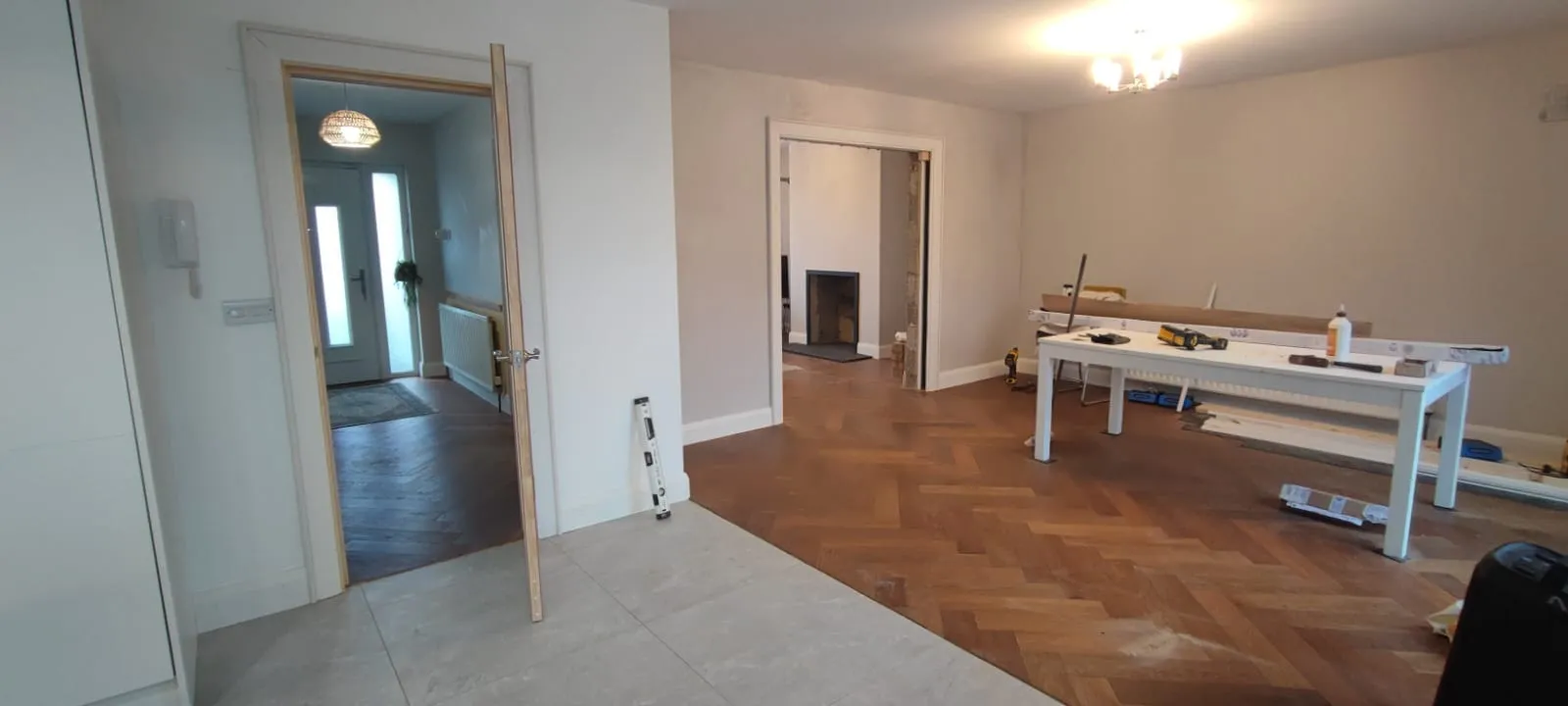
Where a kitchen-diner and living space form a continuous floor, herringbone creates a coherent surface across the whole area without the visual interruption that different board directions in different zones produce. It suits the scale of larger open-plan spaces particularly well.
Period and heritage properties
Herringbone parquet is the traditional floor of Irish and European period houses. In a Victorian or Edwardian property in Dundalk or an older farmhouse on the Cooley Peninsula, herringbone fits the character of the building in a way that wide plank does not. It reads as belonging to the house rather than being imposed on it.
Rooms where a statement floor is the intention
When the floor is meant to be noticed, herringbone delivers. A wide plank floor is elegant and understated. Herringbone makes a claim on the room.
Where Plank Flooring Works Best
Bedrooms and private rooms
A bedroom does not need a floor that makes a statement. It needs a warm, comfortable surface that is quiet underfoot and easy to maintain. Wide plank oak or ash achieves this with less cost and less complexity than herringbone.
Rooms with strong directional natural light
In a room where daylight comes in strongly from one direction, straight boards running perpendicular to the windows can use the light to create depth along the floor. Herringbone in the same conditions can look visually busy as the pattern catches the light from multiple angles.
Budget-constrained projects
Where the flooring budget is fixed and the room area is large, plank flooring covers more area per euro than herringbone. The cost premium for herringbone in labour and waste, typically €25 to €40 per m² more than straight plank in the same material, is real. In a 50 m² open-plan space, that premium is €1,250 to €2,000. In a 15 m² bedroom it is £375 to €600. Both are legitimate considerations.
Rooms with complex geometry
In a room with multiple alcoves, a curved wall, or significant breaks in the floor plan, herringbone’s setting-out requirements become more complex and the waste proportion increases. Straight plank flooring in a complex room is easier to manage and wastes less material.
The Cost Difference
Herringbone costs more than straight plank in the same material for two reasons: more labour time and more material waste.
In engineered oak:
- Straight plank supply and fit: €65 to €90 per m²
- Herringbone supply and fit: €95 to €130 per m²
The premium of €25 to €40 per m² is entirely a function of the fitting process. The material cost of parquet blocks versus plank is similar in comparable grades.
For the full pricing context, the 2026 hardwood flooring cost guide covers both options in detail.
Can You Combine Both in the Same House?
Yes, and it is increasingly common. Herringbone in the hallway and ground-floor open-plan area, plank flooring in the bedrooms upstairs. The two patterns complement each other well when they are in the same species and finish, and the transition at the stair foot is a natural boundary between them.
Where a new staircase or staircase renovation is part of the same project, designing the staircase and floor together produces a result where the timber species and tone are consistent throughout rather than being chosen separately and matched afterwards.
Practical Considerations
Noise: Herringbone parquet, being glued down, tends to be quieter underfoot than floating plank flooring. The adhesive bond between each block and the subfloor eliminates the hollow resonance that floating floors can produce.
Maintenance: Both require the same hardwax oil maintenance routine. Herringbone has more joins per square metre, which means more potential entry points for moisture if the finish is not maintained. It is not a significant practical concern with regular maintenance, but it is worth knowing.
Repair: Replacing a damaged section in a plank floor is straightforward: remove the affected boards and fit replacements. Repairing a section of herringbone requires re-establishing the pattern correctly from the repair outward, which is more involved. For most rooms this is a rare event, but it is worth factoring in for very high-traffic areas.
Frequently Asked Questions
Is herringbone more expensive to maintain than plank flooring? No. Maintenance cost and effort are essentially the same for both. Both require a maintenance coat of hardwax oil every three to five years in a typical domestic setting.
Will herringbone date quickly? Herringbone has been used continuously in European interiors for several hundred years and has gone through multiple cycles of being fashionable and unfashionable. At this point it sits in the category of timeless rather than trendy. It will not look dated in the way that a specific colour or finish choice might.
Does herringbone need a different underlay to plank flooring? Herringbone parquet blocks are almost always glued down to the subfloor rather than floated over an underlay. Plank flooring can be either glued or floated. The method depends on the subfloor type and the specification of the boards. John advises on the correct method at the site visit.
For hardwood flooring across Dundalk, Carlingford, Newry, and Co. Louth, the Setanta hardwood flooring service covers both herringbone parquet and plank options. Contact John on 083 003 3268 to arrange a site visit.