Live Edge Bathroom Vanity and Toilet Seat: Is It Actually Practical?
When Setanta posts photographs of live edge bathroom vanities and hardwood toilet seats, the response is always the same: half the people who see it want one, and the other half ask whether it is practical. The honest answer is: yes, if it is made correctly and maintained reasonably.
This is what you need to know before commissioning timber in a bathroom.
Why Timber in a Bathroom Makes People Nervous
The standard advice for bathroom materials is to avoid anything organic. Ceramic, stone, chrome, and glass are waterproof, resistant to mould, and require minimal maintenance. Timber absorbs moisture, swells, can grow mould, and requires periodic maintenance to retain its protective finish.
All of that is true. It is also true of timber floors, timber staircases, timber window frames, and timber worktops in kitchens, all of which perform perfectly well in Irish homes when correctly specified and maintained. The bathroom environment is more challenging than most rooms, but it is manageable with the right material and finish choices.
What Makes Timber Work in a Bathroom
Species selection
Not all hardwoods are equally suited to a bathroom. The best choices share one property: natural resistance to moisture and decay. The species John uses for bathroom work:
Teak: The most naturally water-resistant hardwood available. Contains natural oils that resist moisture, resists swelling and shrinking more than most species, and is the traditional material for boat decks and garden furniture. For a bathroom vanity where the piece will be regularly wet, teak is the most robust choice. It is also the most expensive.
Oak: The most commonly used hardwood in Setanta bathroom pieces. Well-sealed oak handles bathroom conditions very well. It requires more thorough sealing than teak but performs reliably when correctly finished. The grain figure of oak is well-suited to the live edge aesthetic.
Walnut: Rich dark colour, naturally harder than oak, reasonable moisture resistance. Visually striking in a bathroom. Less commonly used than oak but entirely viable.
Iroko: A West African hardwood with good natural durability and moisture resistance. More affordable than teak with comparable performance characteristics. Used for bathroom pieces where budget is a consideration.
Pine, ash, and lighter-weight domestic hardwoods are less suitable for wet areas. Their cell structure is more open, they absorb moisture more readily, and they are more susceptible to surface mould in the confined humidity of a bathroom.
Finish specification
This is the most important factor in how timber performs in a bathroom.
Hardwax oil: John’s standard finish for most work does not provide sufficient moisture resistance for surfaces in direct water contact, such as a vanity shelf where a wet sink sits, or a toilet seat. Hardwax oil is appropriate for lower-humidity bathroom furniture that does not regularly get wet: a mirror surround, a wall shelf above the bath, a decorative element.
Marine varnish or waterproof lacquer: For surfaces in regular water contact, a properly applied marine varnish or water-based bathroom lacquer provides genuine moisture barrier protection. It is not as natural-looking as hardwax oil but provides the protection that a wet surface requires.
Oil and wax combination: For toilet seats, a Danish oil base coat followed by a furniture wax topcoat provides practical moisture resistance for the intended use while remaining reasonably natural in appearance.
The finish must be applied to all surfaces including the underside and end grain of any piece. Unprotected end grain is the primary route for moisture entry.
Ventilation
Bathroom ventilation is the single biggest factor in whether any organic material performs well in a bathroom. A bathroom with an adequate extractor fan and reasonable air circulation will not develop mould on any correctly finished timber surface. A poorly ventilated bathroom will develop mould on every surface eventually, including grout, silicone, and chrome fittings. If your bathroom has a condensation problem, that is the problem to solve before commissioning timber furniture.
What Setanta Makes for Bathrooms
Vanity shelves
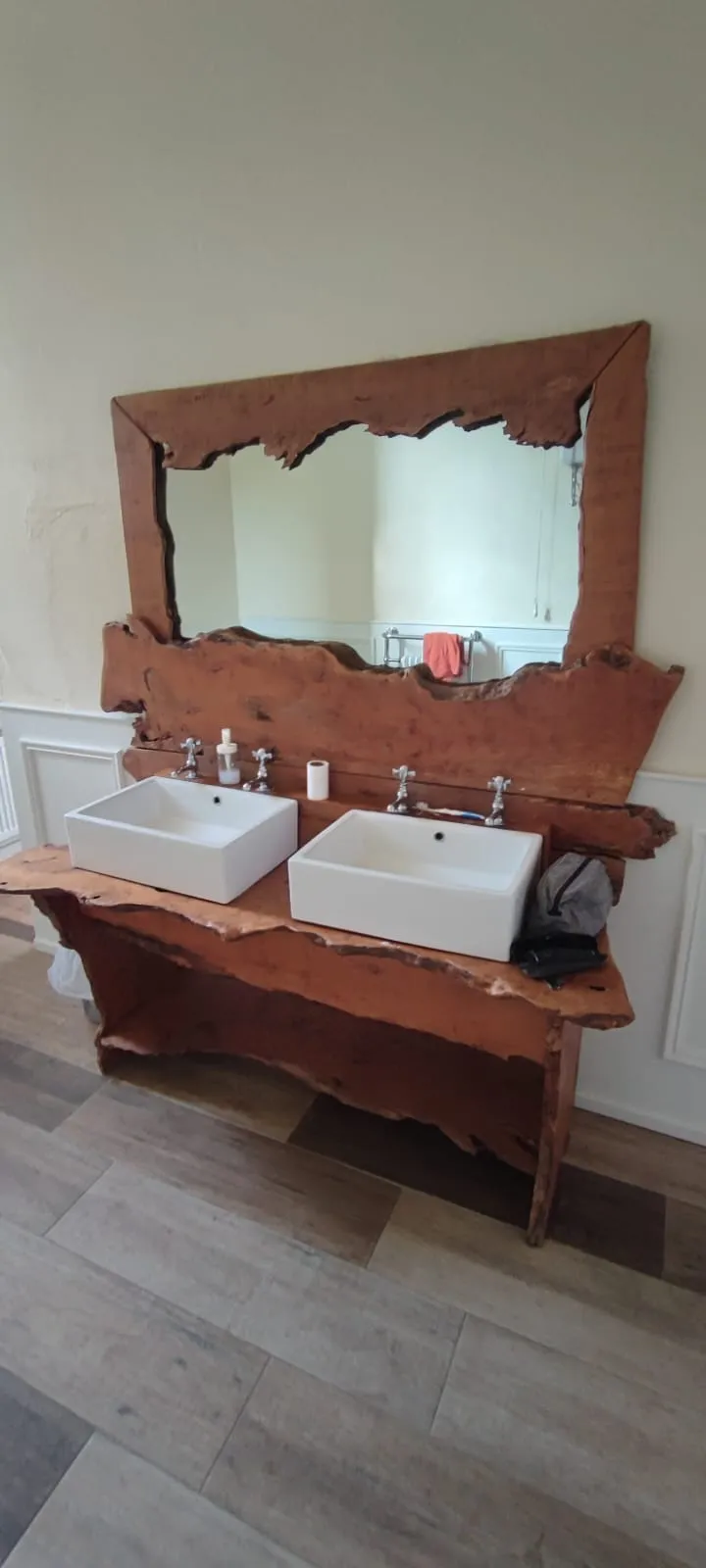
A slab of live edge oak or walnut mounted as a shelf above a wall-hung basin, or as a counter surface with the basin set into it. The live edge faces outward on one or both sides of the shelf. Finished in marine lacquer for contact surfaces, hardwax oil for non-contact areas.
This is one of the most photographed pieces Setanta makes. A wide live edge oak shelf in a white bathroom with chrome fittings is a visual combination that works exceptionally well.
Live edge toilet seats
A solid hardwood toilet seat, made to standard fitting dimensions but in timber rather than the standard resin. Oak, walnut, or teak depending on the client’s preference and budget. Finished in oil and wax for durability and ease of cleaning.
These are working pieces, not decorative ones. The hinge fittings are standard toilet seat fittings. The seat function is identical to a ceramic or resin equivalent. The difference is entirely material and visual.
A frequently asked question: is it hygienic? Yes. A sealed hardwood surface has no more bacteria retention than a smooth resin surface, and less than grout joints. The surface should be cleaned with the same method as any bathroom surface: a damp cloth and a mild bathroom cleaner.
Mirror frames and surrounds
Timber frames for bathroom mirrors, in hardwood or live edge. These are not in regular water contact and can be finished in hardwax oil. They provide a warm element in a bathroom that might otherwise be entirely hard and cold.
Freestanding bath trays and accessories
Timber bath trays, towel rails, and bath caddies. These are the lowest-risk timber bathroom pieces because they are not fixed and can be removed from the water environment when not in use.
What It Costs
For timber bathroom pieces made by Setanta in 2026:
| Piece | Typical Range |
|---|---|
| Live edge oak vanity shelf | €250 to €600 |
| Live edge walnut vanity shelf | €350 to €800 |
| Solid hardwood toilet seat, oak | €180 to €280 |
| Solid hardwood toilet seat, walnut or teak | €250 to €400 |
| Mirror frame, hardwood | €150 to €350 |
These pieces form part of the broader live edge and craft woodwork service at Setanta, alongside dining tables, chopping boards, and bespoke commissions.
Frequently Asked Questions
How often does a hardwood toilet seat need to be maintained? Re-oiling and waxing every six to twelve months keeps the surface in good condition. This takes ten minutes. Clean the seat, dry it, apply a light coat of Danish oil, allow to dry, and buff with a wax. The maintenance commitment is minor.
Can a hardwood vanity shelf support the weight of a basin? Yes. A properly fixed hardwood shelf of 40mm+ thickness can support a wall-hung ceramic or stone basin without difficulty. The shelf fixing method must be appropriate for the wall type and the combined weight of shelf and basin. John advises on the fixing specification at the commission stage.
Are there any bathrooms where you would not recommend timber? A bathroom that has poor ventilation and persistent condensation is not a good candidate for timber, regardless of the finish specification. Address the ventilation issue first.
For live edge bathroom pieces, timber vanity shelves, or hardwood toilet seats in Carlingford, Dundalk, Newry, or across Co. Louth, the Setanta live edge woodwork service covers commissions to order. Contact John on 083 003 3268.