Solid Hardwood vs Engineered Wood Flooring in Ireland: The Honest Comparison
This is the most common flooring question John gets asked at site visits, and it is one that deserves a direct answer rather than a hedged non-answer. Both options are legitimate. Both are real wood at the surface. But they are not interchangeable, and for many Irish homes the choice is not actually open.
What Each Product Is
Solid hardwood is exactly what it sounds like: a board cut from a single piece of timber, the same species and material from top to bottom. Standard domestic solid hardwood planks are 18-22mm thick. The entire thickness can theoretically be sanded away, which is why solid floors can be refinished many more times than engineered.
Engineered hardwood has a real hardwood surface layer, typically 2-6mm of solid hardwood, bonded to a core of high-density plywood or HDF. The cross-ply construction of the core gives engineered flooring significantly greater dimensional stability than solid hardwood, meaning it moves less in response to humidity and temperature changes.
Both options have a real wood surface. The visual difference between them, once laid and finished, is typically undetectable to a non-specialist.
The Critical Factor for Irish Homes: Moisture
Ireland’s climate is the single biggest reason this choice matters more here than in drier climates. The combination of Atlantic weather, older construction with limited vapour barriers, and the humidity swings produced by central heating being turned on and off across the seasons creates conditions that are harder on wood flooring than most.
Solid hardwood moves with humidity. It expands when humidity rises and contracts when the air dries. In a well-controlled environment, this movement is managed by correct installation, appropriate expansion gaps, and adequate acclimatisation before fitting. In an older Irish home with a ground-floor slab, inconsistent heating, or periods of high humidity, this movement can lead to gapping in dry conditions and buckling in wet ones.
Engineered hardwood moves far less. The cross-ply plywood core resists the same humidity-driven expansion and contraction that affects solid boards. This is not a minor difference in practice. It is the reason engineered flooring performs reliably on Irish ground floors where solid hardwood struggles.
Where Each Is the Right Choice
Engineered hardwood is correct for:
- Ground-floor rooms over a concrete slab, with or without underfloor heating
- Rooms with underfloor heating of any type. Solid hardwood is generally not compatible with underfloor heating because the heat cycles drive the very moisture variation that solid flooring handles poorly
- Rooms in older Co. Louth and Cooley Peninsula homes where humidity control is inconsistent
- Any room where the subfloor cannot be guaranteed to be consistently dry
- Kitchen-diners and open-plan living spaces where cooking and occupancy drive humidity variation
Solid hardwood is appropriate for:
- First floor rooms in modern construction with well-controlled heating
- Rooms with suspended timber subfloors where the boards are nailed or secret-nailed into the joists, the traditional method for solid flooring
- Projects where multiple refinishes over a fifty-year lifespan are a priority and the correct subfloor conditions can be ensured
- Heritage properties where a solid hardwood floor is specified to match original construction
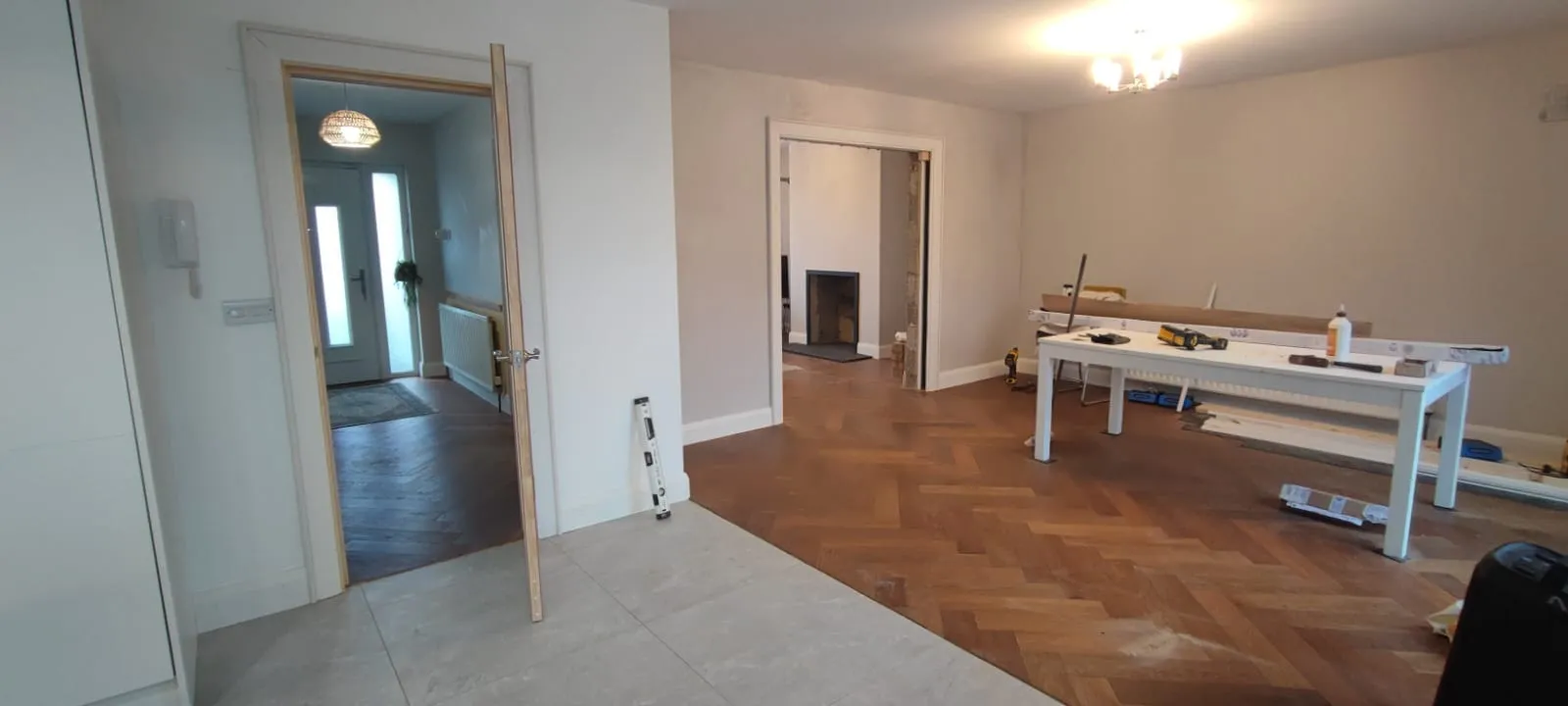
For most domestic flooring projects in Co. Louth and South Armagh, and particularly for ground floors and rooms with underfloor heating, engineered hardwood is the technically correct specification.
The Refinishing Question
The standard argument for solid over engineered is longevity through refinishing. Solid can be sanded six or seven times; engineered with a 2mm wear layer can be sanded once.
This argument has merit but requires context. A quality engineered board with a 4-6mm wear layer can be sanded and refinished two to three times. Given that a well-maintained floor needs refinishing perhaps once every fifteen to twenty years in a normal domestic setting, a quality engineered floor at 6mm wear layer will last thirty to sixty years before refinishing capacity is exhausted. At that point the floor is probably being replaced as part of a larger renovation anyway.
The refinishing advantage of solid hardwood is real but less practically significant than it appears, particularly given the cost and availability of quality engineered boards in Ireland today.
Cost Comparison
The price difference between solid and engineered in comparable quality is narrower than many expect.
Mid-range engineered oak supply and fit: €65 to €90 per m² Mid-range solid oak supply and fit: €75 to €110 per m²
The gap is real but not enormous. At the quality end of the market, premium engineered boards with thick wear layers can cost as much as solid.
The subfloor cost is where the difference sometimes reverses. Solid hardwood on a ground-floor concrete slab may require more extensive damp-proofing and subfloor preparation than engineered. In the right conditions, solid can be nailed directly to a suspended timber subfloor without any additional preparation, which can reduce the total project cost.
For detailed pricing on both options, the 2026 hardwood flooring cost guide gives realistic per-square-metre figures for the Louth and Armagh market.
What John Recommends
The answer at every site visit is determined by the room. For a first-floor bedroom in a modern house with consistent heating, solid oak is an excellent choice. For a ground-floor kitchen-diner or open-plan living room in any Co. Louth home built before 2000, engineered hardwood is the right specification.
The goal is a floor that performs well for the next thirty years, not a floor that matches a specification from a product brochure written in a drier climate.
Frequently Asked Questions
Can I use solid hardwood in a kitchen? Solid hardwood is generally not recommended in a kitchen. The combination of water from sink use, cooking humidity, and the temperature variation from cooking appliances creates moisture conditions that solid hardwood struggles with. Engineered hardwood in a kitchen is a better choice, and it needs to be correctly specified and fitted with appropriate expansion gaps.
Is engineered hardwood as valuable as solid for property resale? Yes. Estate agents and buyers cannot tell the difference visually. A quality engineered oak floor in a living room or hallway has the same positive effect on a property valuation as solid oak. The specification matters; cheap engineered flooring with a thin wear layer does not have the same standing as quality solid hardwood.
I have underfloor heating. Which option do I need? Engineered hardwood, specified as compatible with underfloor heating. Not all engineered boards are suitable; the specification must match the heating system. John advises on this at the site visit.
For hardwood flooring advice and supply and fit in Dundalk, Carlingford, Newry, or across Co. Louth, the Setanta hardwood flooring service starts with a site visit and honest assessment. Call John on 083 003 3268.