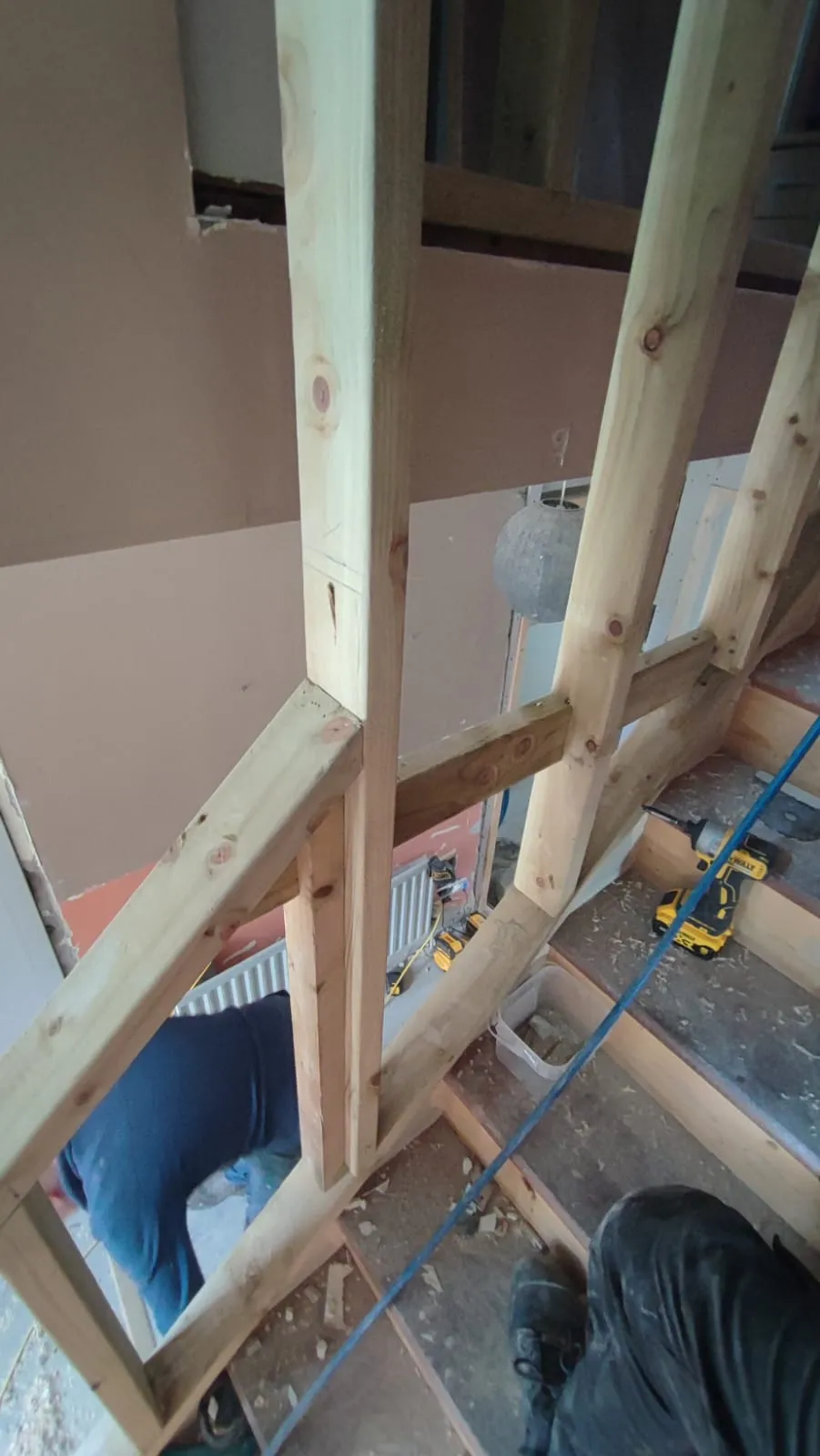
Staircase Construction vs Staircase Cladding: What Is the Difference and Which Do You Need?
Most homeowners beginning a staircase renovation assume they need a new staircase. In the majority of cases, they do not. Staircase cladding is a less-discussed option that solves the same problem at significantly lower cost, and in most renovation scenarios in Co. Louth and South Armagh, it is the right approach.
Understanding the difference is worth a few minutes before you start getting quotes.
What Staircase Cladding Is
Staircase cladding involves fitting solid hardwood treads and risers directly over your existing staircase structure. The old structure stays in place. New hardwood components are precision-cut and fixed on top of it.
At the same time, the balustrade is typically replaced. The old spindles, newel posts, and handrail come out. New solid hardwood newel posts, spindles, and a hardwood handrail go in.
The finished result looks identical to a brand new hardwood staircase. From the front, there is no visible difference. The entire visible surface is new hardwood, fitted correctly, with proper balustrade detailing.
What Full Staircase Replacement Is
Full replacement means stripping the existing staircase out completely, down to the structural trimmer joists at the top and bottom, and building an entirely new staircase in its place. Every component, strings, treads, risers, balustrade, and handrail, is new.
This is more disruptive, takes longer, and costs considerably more than cladding.
When Cladding Is the Right Option
Cladding works where the existing staircase structure is sound. Sound means:
- The strings (the side boards running from floor to floor) are not cracked, rotten, or structurally compromised
- The carriage (the central support timber underneath the staircase) is intact
- The existing treads and risers are fixed firmly and do not flex significantly under load
- The staircase layout and position in the house suits the new design. Cladding cannot change a staircase’s footprint, rise, or run
If all of these conditions are met, cladding is almost always the better choice. It costs 40-60% less than full replacement for the same hardwood finish.
The majority of staircases in homes built across Co. Louth, South Armagh, and the Dundalk-Newry corridor in the 1970s through to the 2000s are in this category. They were built in softwood or MDF, carpeted, and structurally sound. Cladding them in solid oak produces a transformation that a homeowner would never know was not a new staircase.
When Full Replacement Is the Right Option
Full replacement is necessary when:
The structure is failing. Strings that have cracked or delaminated, a carriage that has sagged or rotted, or treads that flex badly under load indicate a structure that is not worth cladding. Fixing hardwood components to a failing substrate produces a failing hardwood staircase.
The layout needs to change. Cladding is a surface treatment. It cannot alter the rise, run, width, or position of the staircase. If a renovation has changed the floor plan, if the hallway has been opened up and the staircase now sits in a different visual context, or if building regulations require a different geometry, a new staircase is the only option.
The existing design is too dated to work with. Some older staircases have a string profile, newel post position, or overall geometry that is so incompatible with a contemporary hardwood finish that it would look wrong regardless of the cladding quality. In these cases, a new staircase produces a better result.
The rise or tread depth does not meet current building regulations. Particularly relevant in older houses where the staircase was built before modern regulations. If the staircase is too steep or the treads too narrow, it may need to be rebuilt to comply.
The Cost Difference
To illustrate why the choice matters, here is a realistic comparison for a straight flight staircase in solid oak for the Co. Louth market in 2026:
| Approach | Typical Cost |
|---|---|
| Cladding, straight flight, oak treads and risers, new balustrade | €3,500 to €6,500 |
| Full replacement, straight flight, solid oak throughout | €6,000 to €10,000 |
| Saving from choosing cladding where applicable | €2,500 to €5,000 |
For an L-shaped staircase with a landing, the saving is proportionally similar. The full staircase cost guide covers the complete pricing picture for both options.
How John Assesses Your Staircase
At the site visit, John carries out a structural assessment of the existing staircase before recommending cladding or replacement. He checks:
- The strings for cracks, movement, and fixings
- The carriage for integrity and any visible sagging
- The individual treads for flex, fixings, and rot at the front nosing where wear is highest
- The overall geometry against current building regulations
He will give you a straight answer on which approach is right, with an explanation of why. If your staircase is claddable, he will tell you. If it is not, he will tell you that too, and explain what replacement would involve.
A Third Option: Balustrade Replacement Only
Where the treads are in acceptable condition but the balustrade is the main problem, a targeted replacement of spindles, newel posts, and handrail alone is worth considering. This is the most cost-effective staircase upgrade available, typically running €1,500 to €3,500 in solid hardwood.
It does not address worn or damaged treads, but in a house where the treads are in reasonable condition and the staircase is carpeted anyway, it can transform the visible character of a hallway at a fraction of the cost of a full renovation.
Frequently Asked Questions
Can you clad over a concrete staircase? Yes, with the right approach. Concrete staircases are found in some older Irish houses and in commercial properties. Hardwood treads can be fixed over concrete using appropriate adhesive and mechanical fixings. John assesses these on a case-by-case basis.
Will cladding affect the headroom on the staircase? Marginally. Oak treads typically add 20-22mm of height to each tread surface. Across a full flight this reduces the headroom at the top by one tread thickness. In most Irish homes this is not a problem, but John accounts for it at the assessment stage.
Does cladding make a staircase noisier or creak more? If done correctly, no. Creaking on a cladded staircase is usually caused by inadequate bonding between the new tread and the old substrate. John uses both adhesive and mechanical fixings to prevent movement between the two surfaces.
For a staircase assessment in Dundalk, Carlingford, Newry, or across Co. Louth, contact Setanta Woodcraft to arrange a site visit. John will assess the staircase and advise on cladding or replacement before any quote is issued.