Signs You Need New Hardwood Flooring, Not Just a Refinish
A hardwood floor is not a disposable product. A good solid oak or engineered floor, correctly installed and reasonably maintained, should last decades. But floors do fail, particularly in older Irish homes where moisture management was not a consideration at installation time, and knowing when refinishing will solve the problem versus when replacement is the only real answer saves both time and money.
These are six signs that your floor has moved beyond what sanding and refinishing can address.
1. The Boards Are Cupping or Crowning
Cupping means the edges of each board have risen higher than the centre, giving the floor a corrugated, undulating surface. Crowning is the reverse: the centre of each board has risen above the edges. Both are caused by moisture imbalance in the timber.
Cupping typically occurs when the underside of a board absorbs more moisture than the top surface, usually from a ground-floor slab with residual moisture or from a leak. Crowning usually happens after cupped boards have been sanded flat while still wet, and then dried out, reversing the distortion.
Mild cupping in a floor that has been exposed to a temporary moisture event, and where the moisture source has been addressed, can sometimes resolve itself over time and subsequently be sanded flat. Severe cupping, boards that have moved significantly and remain deformed after the moisture source has been resolved, indicates structural movement in the boards that sanding cannot adequately correct. Replacement, with proper moisture management of the subfloor this time, is the right approach.
2. The Wear Layer Has Been Exhausted
Every hardwood floor has a finite number of times it can be sanded. For solid hardwood, that number is relatively high, typically five to seven full sands across a lifetime depending on the original thickness. For engineered hardwood, it depends entirely on the thickness of the hardwood wear layer: a 2mm wear layer can be sanded once, gently; a 6mm wear layer can be sanded two to three times.
The point of exhaustion is when the sanding process would reach the underlying material, whether that is the softer core of a solid board below the dense surface layer, or the plywood core of an engineered board.
Signs that the wear layer is near or at exhaustion: sanding marks from previous work that are visible through the surface finish, areas where the grain pattern has become very faint or the surface appears nearly translucent, or a floor that was recently sanded and already shows significant wear again within a few years because there was too little material left to hold a meaningful finish.
3. Structural Damage Beyond the Surface
Surface scratches, dents from furniture, and worn finish are refinishable. Structural damage is not.
Structural damage includes:
- Boards that have split along the grain across their full thickness, not just surface cracks
- Boards that have broken at a join or end, leaving a gap or an abrupt height change
- Sections where the timber has been crushed rather than scratched, typically from point loading under heavy furniture without adequate protection
- Deep cuts or gouges that penetrate below the wear layer
Individual structural failures in an otherwise sound floor can sometimes be addressed by replacing the affected boards. Where structural damage is widespread, patching becomes impractical and replacement makes more sense.
4. Significant Gapping That Has Not Resolved
Hardwood boards expand and contract with seasonal humidity changes. Some degree of gapping in winter, when indoor air is drier, is normal and expected. Those gaps should close when humidity rises again in summer.
Gaps that persist year-round, that have widened progressively over several years, or that have reached a width where dirt and debris accumulates and the floor sounds hollow when walked on, indicate a floor that was either incorrectly installed or has moved beyond its tolerance.
Persistent gapping in a solid floor often points to a floor that was laid in unsuitable conditions, either too wide for the species, laid too dry in a space that is consistently humid, or laid without adequate expansion gaps at the walls so the boards have nowhere to move but apart.
Refinishing does not address gapping. The gaps can be filled with coloured filler as a temporary measure, but the movement that created them continues. If the source of the gapping is a fundamental installation problem rather than a repairable maintenance issue, replacement with correct specification is the right approach.
5. Rot, Damp Damage, or Persistent Moisture
Rot in a hardwood floor is serious and is not reversible by refinishing. Affected boards become soft, darker in colour at the edges or ends, and have a faintly sweet or mushroom-like smell when disturbed.
The source of the rot must be identified and addressed before any new floor is laid. Common causes in Co. Louth and South Armagh homes include:
- Ground-floor slabs without damp-proof membranes in older properties
- Leaks from under-floor pipework
- Condensation in poorly ventilated rooms, particularly in solid-wall construction
Isolated rot affecting one or two boards, with the moisture source resolved, can be treated by board replacement. Rot affecting a significant area of the floor, or a floor over an actively damp slab, requires full replacement with correct moisture management throughout.
6. The Floor No Longer Suits the Room
This is the least urgent of the six signs but often the most honest reason for replacement. A floor that was adequate when it was laid but which has been overtaken by a renovation, a change in the room’s use, or simply better taste, is a floor that has served its purpose.
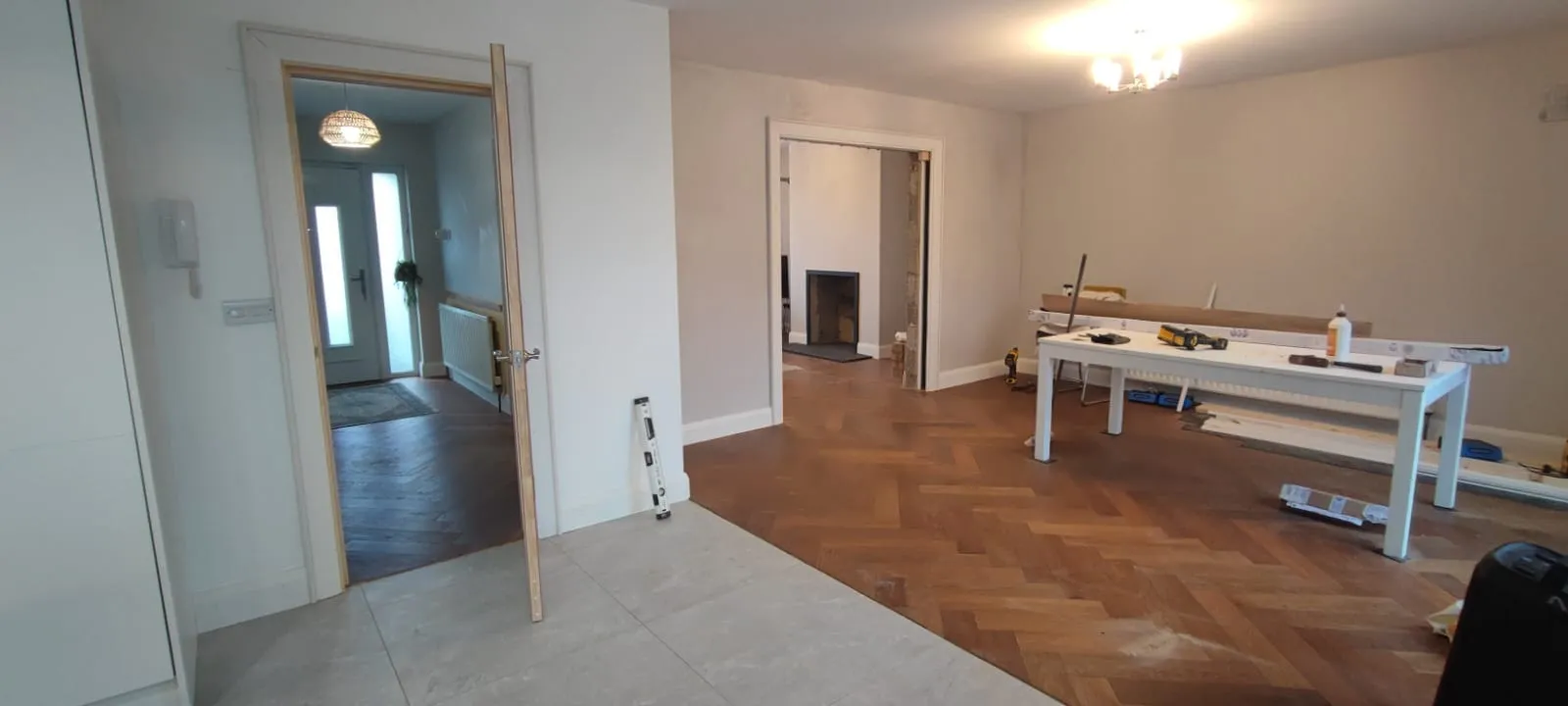
A dark stained oak floor in a room that has been updated to a lighter, more contemporary scheme. A narrow-plank floor in a room that would benefit from a wider board or herringbone pattern. An old floor whose species and finish no longer complement the joinery, kitchen, or staircase in the same house.
These are aesthetic rather than structural decisions, but they are valid ones. A hardwood floor that actively works against the room it is in does not need to stay. The comparison between herringbone and plank flooring covers the design considerations when choosing what to replace it with.
Frequently Asked Questions
My floor is cupping in one section but fine elsewhere. Does the whole floor need to come up? Not necessarily. If the cupping is localised, the cause is likely localised too, a pipe leak, a damp patch in the slab, or a poor joint in the damp-proof membrane beneath. Addressing the moisture source and replacing the affected section is possible if the rest of the floor is sound. John assesses this at the site visit.
Can I sand out deep scratches? Deep scratches that have penetrated below the surface layer of the board can be sanded out if there is sufficient wear layer remaining. The question is always how much material will be removed in the process and whether there is enough left after sanding to apply a meaningful finish. John can assess this without committing to a full refinish.
How much does floor replacement cost versus refinishing? Refinishing an existing floor costs €15 to €30 per m² including sanding and two coats of oil. New floor supply and fit runs €65 to €160 per m² depending on specification. The 2026 flooring cost guide covers the full pricing picture.
For an assessment of your existing floor in Dundalk, Carlingford, Newry, or across Co. Louth, the Setanta hardwood flooring service includes a site visit and honest assessment before any quote is issued. Call John on 083 003 3268 to arrange.