Signs Your Wooden Doors Need Replacing, Not Just Repainting
A coat of paint buys time. It does not fix rot. It does not straighten a warped stile. And it does not restore the weathertight seal of a frame that has moved beyond what adjustment can correct.
Knowing when a timber door has reached the point where maintenance is no longer the answer saves the money spent on repeated short-term repairs, and more importantly, it saves the ongoing cost of a door that is not doing its job.
1. The Door Sticks Seasonally and the Problem Is Getting Worse
All timber doors move slightly with seasonal humidity changes. A door that is marginally tight in the height of summer, when the timber has expanded with atmospheric moisture, and then swings freely in winter is behaving normally. This is not a sign of a failing door.
A door that has been sticking more severely each summer, or that now sticks year-round rather than only in the wet season, is telling you something different. The timber has taken on a set: it has moved and stayed moved. This happens when the door has been in contact with moisture for long enough to permanently alter the equilibrium of the timber in the frame.
Planing a sticking door is a temporary fix where the door is genuinely distorted. You remove material to create clearance, but the underlying moisture condition that caused the movement has not changed. The door continues to absorb and release moisture and continues to move. Each year’s repair removes more timber, eventually reaching the point where there is not enough left to make the door function correctly.
2. Visible Rot at the Base of the Door or Frame
Rot at the base of an external door or frame is the most common failure point in older Irish homes. The base of the door, the bottom rail, sits closest to ground-level moisture: rain splash, pooling water at the threshold, and capillary moisture from the step below.
On a door that was not adequately protected, or where the protective finish has been allowed to fail, moisture enters the end grain of the bottom rail. End grain is the most absorbent surface of timber. Once moisture is established in the end grain, the rot process begins.
Signs that rot has reached a problematic level:
- Softness or sponginess when you press the bottom corner of the door
- Paint that has blistered or peeled at the bottom of the door on the exterior face
- A visible crack or separation at the join between the bottom rail and the stile
- Dark staining or discolouration that has penetrated beneath the paint layer at the door base
- A musty smell from the door when the weather is wet
Early-stage rot in the bottom rail of an otherwise sound door can sometimes be addressed with timber repair products and a proper re-finish. Once the rot has reached the mortice-and-tenon joints at the bottom corners, the structural integrity of the door is compromised and replacement is the correct approach.
3. Draughts That Cannot Be Fixed with New Seals
A draught through an external door is usually one of three things: a gap between the door and the frame, a failing threshold seal, or movement in the frame itself that has created a gap that does not close even when the door is latched.
The first two can be addressed without replacing the door. New compression seals or brush seals at the jambs and head, a new threshold seal at the bottom, and potentially a hinge adjustment to bring the door tighter against the frame will resolve most draughts in a door that is otherwise sound.
If new seals do not resolve the draught, the issue is likely the third: the frame has moved, distorted, or shrunk away from the wall opening in a way that creates a consistent gap. This is a frame problem, not a seal problem. The frame needs to be assessed and either consolidated and resealed, or replaced.
An external door that lets in a consistent draught regardless of the seal quality is costing money in heat loss every day it is left in place. On an older Co. Louth property without cavity wall insulation, a poorly sealing external door is one of the most significant ongoing energy costs in the building envelope.
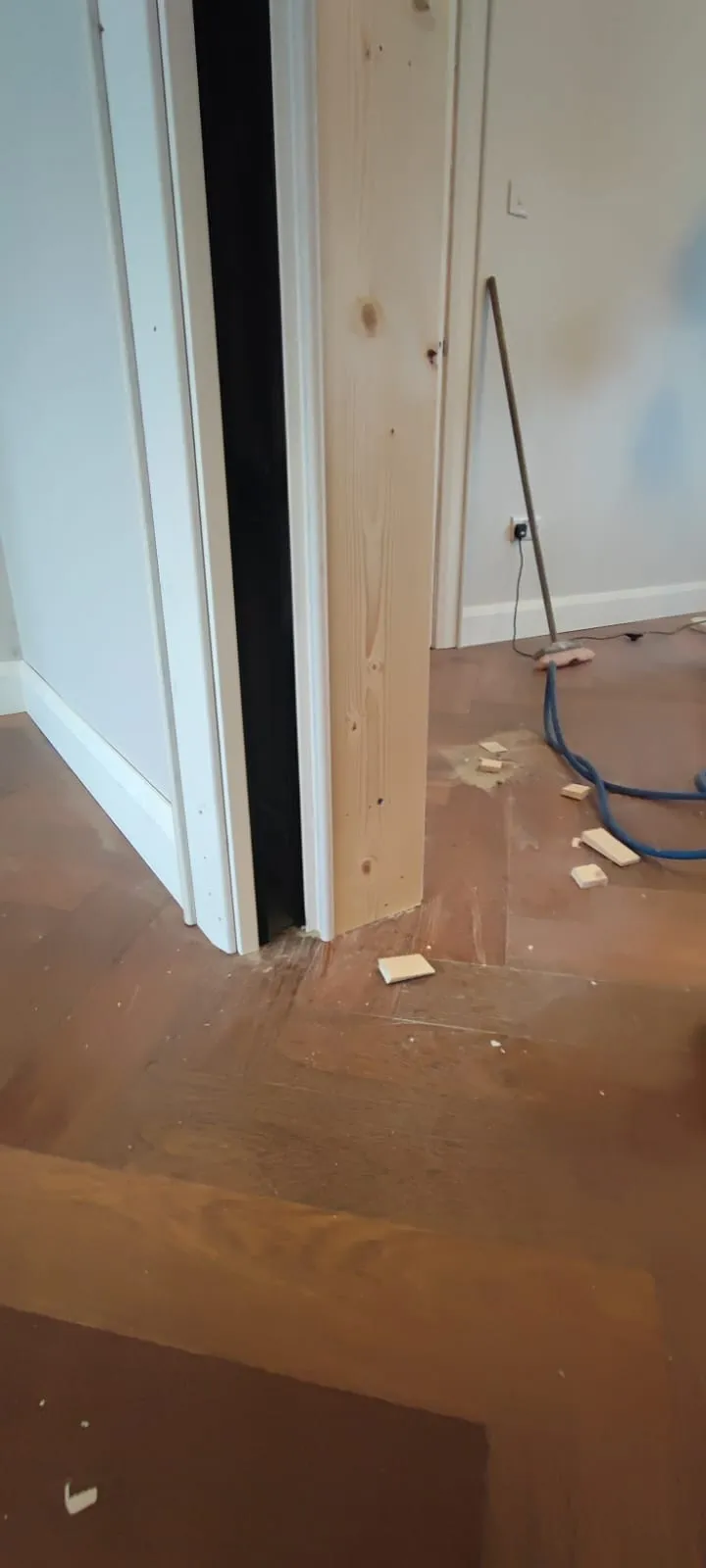
4. The Frame Is Rotten at the Wall Junction
The junction between the door frame and the external wall is a common point of moisture entry in Irish homes, particularly in solid wall construction where the frame was originally bedded in lime mortar or similar material that has since cracked or degraded.
Signs of frame rot at the wall junction:
- Paint lifting or cracking at the junction between the frame and the wall reveal
- A visible gap between the frame and the wall that was not there previously
- Softness in the frame timber at the point where it meets the wall
- Staining on the interior wall surface adjacent to the frame, indicating water ingress
Frame rot at the wall junction is a more serious problem than door-leaf rot because the frame carries the door’s weight and provides the weatherproofing interface with the wall. A rotten frame that has lost its structural integrity should not have a new door hung in it. The correct sequence is new frame followed by new or existing door, depending on the door’s condition.
5. The Door Has Warped Significantly Out of Plane
A flat door hanging in a square frame should, in theory, maintain its flatness. In practice, Irish conditions introduce enough moisture cycling to cause some timber doors to develop a bow or twist over time, particularly if one face of the door was exposed to significantly more moisture than the other.
A slight bow that develops and retreats with the seasons is manageable. A door that is visibly twisted, where one corner stands proud of the frame when the door is latched, has taken a permanent set that will not resolve by drying out. A twisted door cannot be sealed correctly at all four corners simultaneously. It lets in draughts and rain at the high corner and binds at the low corner.
This level of warping is not repairable. Replacement is the right call.
6. The Door No Longer Suits the House
This is less urgent than rot or structural failure but equally valid as a reason to replace. A period house in Carlingford that has been renovated throughout with quality joinery, but retains an original hollow-core or cheaply replaced internal door, has a mismatch that undermines everything else in the room.
A bespoke replacement door, made to the exact opening in solid hardwood and properly finished, is a final piece of a renovation that makes the whole project feel complete. The Setanta doors service covers this scenario as routinely as structural replacement.
Frequently Asked Questions
Can rotten timber be repaired rather than replaced? Sometimes. Early-stage surface rot can be treated with epoxy repair systems that consolidate the timber and restore the surface. This is appropriate for isolated damage in an otherwise sound door or frame. Where rot has reached the structural joints or affected a significant proportion of the component, repair products are a temporary measure and replacement is more cost-effective in the long run.
Should I replace the door, the frame, or both? It depends on the condition of each. If the door is sound but the frame is failing, a new frame and rehanging the old door is a viable approach. If both are failing, replacing together is more economical than doing them separately. John assesses this at the site visit before any recommendation is made.
How long should a properly maintained hardwood external door last? A well-made hardwood door, correctly finished and maintained with periodic repainting or re-oiling every five to seven years, should last thirty to fifty years. The most common reason for premature replacement is neglected maintenance rather than inherent material failure.
If your external door or frame is showing signs of failure in Dundalk, Carlingford, Newry, or across Co. Louth, contact Setanta Woodcraft to arrange a site visit. For an idea of what replacement costs, the 2026 door cost guide gives realistic figures for the Louth and Armagh market.