What Is Live Edge Wood and How Is It Worked by a Craftsman?
Live edge has become a term used by furniture retailers to describe almost anything with a curved or irregular edge. The word has been stretched far enough that it can now apply to a rubber wood table with a factory-moulded wavy edge painted brown.
This guide explains what live edge actually is, why it produces furniture that is genuinely different from everything else, and what the process of working a live edge slab looks like in the Setanta workshop.
What Live Edge Actually Means
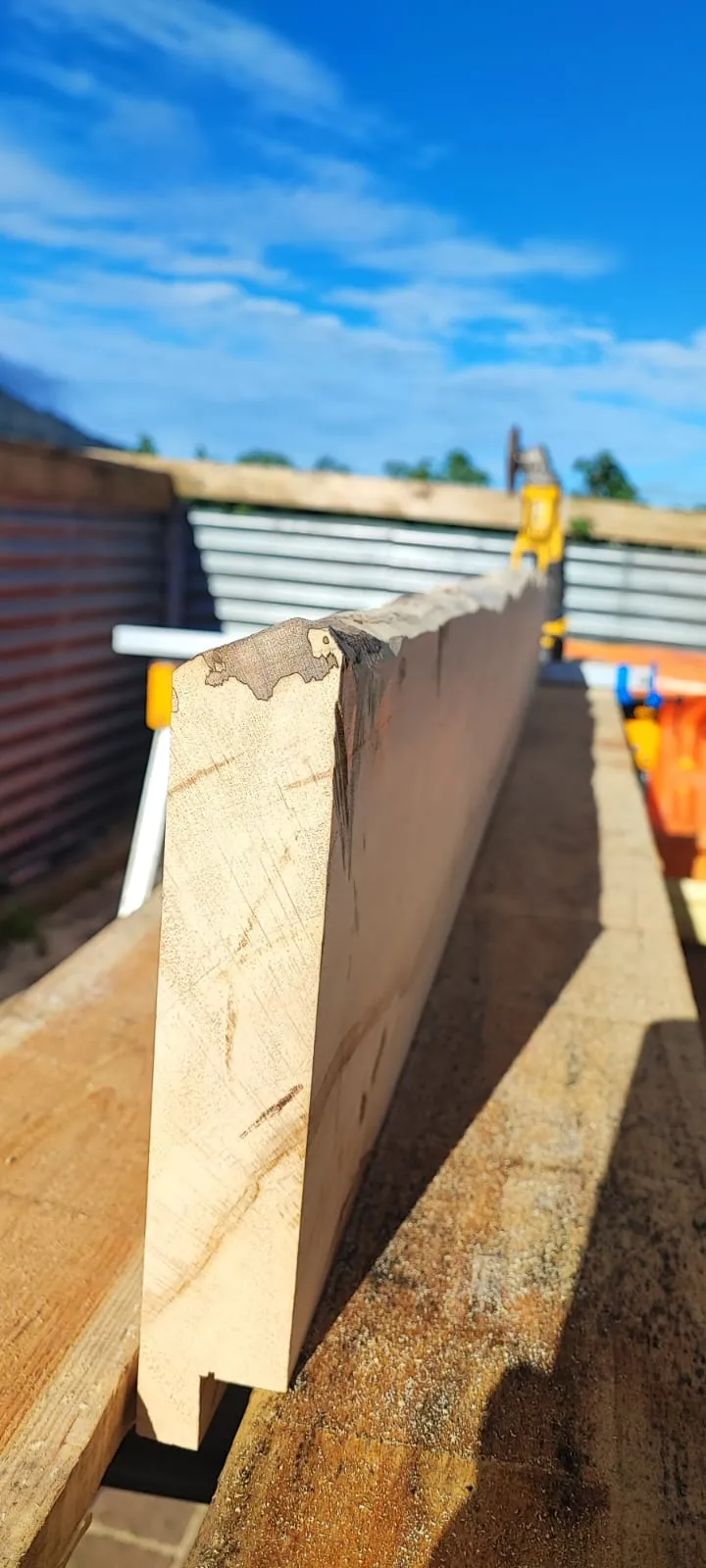
Live edge means the natural outer edge of a timber slab has been retained. When a log is cut lengthways into boards or slabs, the conventional approach is to remove the bark and the sapwood, producing a board with clean, straight, parallel edges. Live edge means keeping that outer edge, including the bark line, the sapwood, and the natural contours of the tree’s outer surface.
The result is a board or slab with two straight-cut surfaces at top and bottom, and one or two edges that follow the original form of the tree. No two pieces of live edge timber have the same edge profile, because no two trees grow in exactly the same way.
This is not a surface treatment or a style. It is simply timber that has been processed to retain what a conventionally milled board removes.
What Makes a Good Live Edge Slab
Not every slab is worth working. John assesses potential slabs against several criteria before committing to a commission.
Width: A dining table needs a slab of at least 700mm finished width, preferably 800-900mm. A coffee table can work with 450-600mm. A shelf can be made from a narrow offcut. Width is the scarcest quality in live edge slab because wide trees are rare. A slab wide enough for a dining table from a native Irish oak is a piece of material that took sixty to eighty years to produce.
Figure: The character of the grain varies enormously within the same species. Straight-grained timber is plain and workable. Highly figured timber shows curl, ray fleck, burr, or complex swirling grain that makes the piece visually extraordinary. Figure comes from stress in the growing tree: a limb junction, a wound that healed, an asymmetric growth pattern. You cannot create figure in a straight-grained piece. You find it or you do not.
Soundness: Checks (small cracks radiating from the pith), voids (gaps left by decay or branches), and splits are common in wide slabs. Checks and small voids can be filled with matched epoxy or retained as a design feature of the piece. Structural splits that compromise the integrity of the slab are a disqualifying problem.
Drying: The most important single quality criterion. Timber must be adequately dry before it can be worked into furniture. Green timber continues to shrink as it dries. A table made from undried slab will develop significant cracks, cupping, and joint failure within a year of completion. Properly air-dried or kiln-dried slab is more expensive and takes longer to source. It is non-negotiable for furniture that will be used.
The Process: From Slab to Finished Piece
Selecting and acquiring the slab
John sources slabs from Irish timber suppliers, from the Board Room NI in Northern Ireland, and occasionally from timber that has come down on clients’ own land. Slab sourcing is not a transactional purchase. It involves assessing multiple options for each commission, understanding what each slab is suited for, and matching the material to the brief.
For a client who has commissioned a dining table with a specific slab style in mind, John will photograph and describe available options before the final selection is made. The slab is the piece. The selection matters.
Flattening
A raw slab is rarely flat. The wide face bows across its width, the ends lift slightly, and there may be local surface variation from the milling process. Before any design work can proceed, the slab must be flattened.
John uses a router sled to flatten large slabs: the router travels on rails set above the slab’s highest point, gradually removing material until the surface is consistent. This process produces a flat reference face. The second face is then flattened in reference to the first, producing parallel surfaces.
Filling voids and checks
Voids and checks in the slab are assessed for their character contribution to the piece. A void that cuts through the width of a dining table weakens it structurally and must be filled. A small void in a position that does not affect function may be retained and sealed with a compatible product.
Where voids are filled, John uses coloured epoxy matched to the tone of the surrounding timber, or contrasting epoxy where the design intention is to make the fill a feature of the piece. Butterfly keys, small wooden bow-tie inlays across a check, are a traditional method of both reinforcing a crack and declaring it honestly as part of the piece’s history.
Sanding
The flattened slab is sanded through progressively finer grits, from 60 or 80 grit to remove tool marks and high spots, through 120, 180, and 240 grit to produce a surface ready for finishing. The edge work, where the natural bark surface transitions to the finished face, requires particular care. The bark line is often cleaned and stabilised rather than removed.
Finishing
Hardwax oil is the standard finish at Setanta for live edge work. Two to three coats, applied by hand with a cloth and buffed. Each coat penetrates the timber and feeds the grain, enriching the colour and producing water and dirt resistance without creating a surface film that obscures the natural quality of the material.
The difference between a hardwax-oiled slab and an unfinished one is immediate and striking. The grain figure comes forward, the colour deepens, and the natural character of the material is shown at its best.
Base fabrication and attachment
The base is made or sourced separately and attached to the finished slab. The method of attachment matters for the long-term performance of the table. A wide slab cannot be rigidly fixed to a steel base without allowing for its seasonal movement. Slotted brackets or button fixings that allow the slab to expand and contract across its width while remaining securely attached to the base are the correct approach.
For the full cost picture on live edge dining tables, the 2026 live edge cost guide covers what drives pricing.
Frequently Asked Questions
Is live edge timber structurally weaker than straight-cut timber? No. The natural edge of the slab has no structural significance for most applications. The slab is as strong as the same width of straight-cut timber from the same species.
What happens to the bark on a live edge piece? The bark on a fresh slab is usually removed before working, because it dries and separates from the sapwood over time. The bark line, the edge profile of the outer surface of the tree, is retained. The sapwood, the pale outer layer beneath the bark, can be retained or removed depending on the design intent.
How do I know a live edge piece is genuinely what it claims to be? The natural edge profile of a real live edge slab is irregular in a way that cannot be perfectly replicated by moulding or routing. Real live edge shows the variation in the bark line, differences in sapwood width, and the slight undulation of the outer surface of a growing tree. A factory edge profile, however artfully done, reads as uniform under close inspection.
For live edge furniture and craft pieces in Carlingford, Dundalk, Newry, and Co. Louth, the Setanta live edge woodwork service covers commissions from dining tables to chopping boards. Contact John on 083 003 3268.